 Skip to main content
Beef Farmers of Ontario's three-year Research Strategy (2025-2028) has been developed to guide investments in research and knowledge translation and transfer (KTT). The Strategy provides a roadmap to support a competitive, sustainable and resilient Ontario beef sector by identifying priority areas for research, collaboration, and application of knowledge.
The goal of BFO’s Research Program is to increase the development, adaptation, assessment, and easy adoption of on-farm tools and technologies that help beef farmers respond to changing demands. BFO contributes over $1.1 million annually to support research initiatives, including a three-year research call, and funding to the Beef Cattle Research Council (BCRC) and the Livestock Research Innovation Corporation (LRIC). BFO also puts strong emphasis on producer engagement, which often encompasses KTT, connecting farmers with researchers and the latest in beneficial management practices, industry resources and current technologies. BFO has made additional investments in recent years to address immediate sector challenges and provincial/cross-sector initiatives, such as the Living Labs – Ontario project.
The Strategy is organized around five areas that encompass specific outcomes and research objectives:
- Animal Health & Welfare
- Forage & Feed Production
- Feed Efficiency & Utilization
- Beef Quality & Food Safety
- Knowledge Translation & Transfer
Under each of the five overarching themes, there are specific objectives and research questions that the industry has identified as important considerations when making research investments. While not all areas may be funded simultaneously, each theme represents a critical component of a balanced and forward-looking research portfolio for the Ontario beef industry. The order listed is not representative of their prioritization.
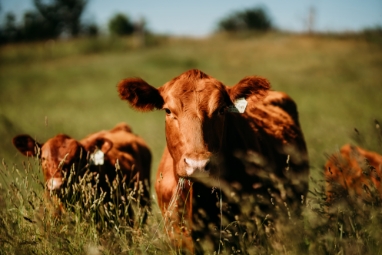
Beef Farmers of Ontario Research Strategy (2025-2028)
ANIMAL HEALTH & WELFARE
- Why do some cattle not respond well to treatment and develop a variety of chronic diseases? How can this be prevented?
- Research technologies for early detection and identification of disease (including but not limited to respiratory illness and pink eye).
- Can new management methods be found to prevent resistance (i.e. anthelmintics and antibiotics).
- Promotion of standardized preconditioning best management practices across cow-calf producers.
- Benchmarking for calf health parameters
- How can the industry continue to build on adherence to the animal care codes practice?
- Research potential correlations between respiratory diseases and ventilation in feedlot barns.
- How do cattle handing facilities impact the economic and health aspects of cattle on pasture, in feedlots, and in auction barns.
- Exploring the relationship between animal comfort, handling practices,
FORAGE & FEED PRODUCTION
- How can beef production systems be better integrated into cropping systems?
- How can cover crops and crop residue be better utilized in beef production?
- What are sustainable strategies for handing difficult weeds in forages?
- Research the benefits of cross-species grazing (e.g. cattle and sheep).
- What is the economic and environmental return of measuring pastures in an Ontario grazing system, and what is the ideal methodology for measurement?
- What is the current and potential carbon sequestration capacity of Ontario’s existing pastures? How does management influence carbon stocks over time to support expansion and collaboration among groups (e.g. Ducks Unlimited, conservation authorities, nature conservancy organizations, and CANZA)?
- What is the greenhouse gas mitigation potential of diverting food waste and agro-industrial by-products from landfills and upcycling them as livestock feed in Canada, across beef feedlots and other major livestock sectors?
- Research focused on forage breeding specific to Ontario (Canadian) climate conditions, including regional variety trials.
- KTT focused on opportunities for improved performance that can be achieved with pasturing beef cattle.
FEED EFFICIENCY & UTILIZATION
- What are ways to make cattle more efficient on pasture with improved forage utilization and grazing management?
- Improving genetic evaluations that directly or indirectly influence traits that impact economic outcomes for beef producers.
- How do barn structures and flooring affect traction and sound footing, and how does it relate to feed conversion and lameness?
- How can beef producers utilize digital technology to address labor shortages both on the farm and at processing?
- What are the best ways to measure and/or identify efficiency in the beef cow herd?
- What are the best management practices and economic considerations for forage-feeding dairy × beef calves?
BEEF QUALITY & FOOD SAFETY
- How do genetics impact meat quality and nutritional components for the consumer?
- What motivates consumers and their willingness to pay for specific attributes in beef?
- What technologies can be developed or adopted to improve and integrate traceability across the entire beef supply chain and provide value to the farmer?
- What role can data, technology, or standardized practices play in reducing inconsistencies in beef grading?
KNOWLEDGE TRANSLATION & TRANSFER
- What methods can be employed to effectively connect with and engage Ontario producers, recognizing the diversity of production systems, regions and business models across the province?
- How can cross sector social research support the development of a more collaborative ecosystem for research lifecycle, including implementation, realization and commercialization?
- What is the most effective approach for communicating research findings to Ontario beef producers in ways that are accessible, relevant, and easy to understand and apply when appropriate?
- How can KTT needs be identified based on current practices, both within the beef sector and across the livestock/agricultural sectors (e.g. importance of vaccination protocols.